 I just launched a new website where I'll be posting my writing and audio stories from now on. So please join me on mirandaesbennett.com!
January 20, 2016
New Website!
I just launched a new website where I'll be posting my writing and audio stories from now on. So please join me on mirandaesbennett.com!

December 13, 2015
Singing strength with Note-oreity
I was skeptical when I got the assignment to put together a piece on an a cappella group about their popular video. I've never been one for a cappella and I didn't think a Beyonce cover was going to convert me. And it didn't. But what struck me was how much these women believe in the social good of music. They really want to change the world with their songs. Skip to 5:21 to listen to the segment:Here's a link to their music video.

October 29, 2015
Constant Reinvention with Alexander "Buck" Giannini
 |
| An advertisement for Buck's salon from the early 1990s. |
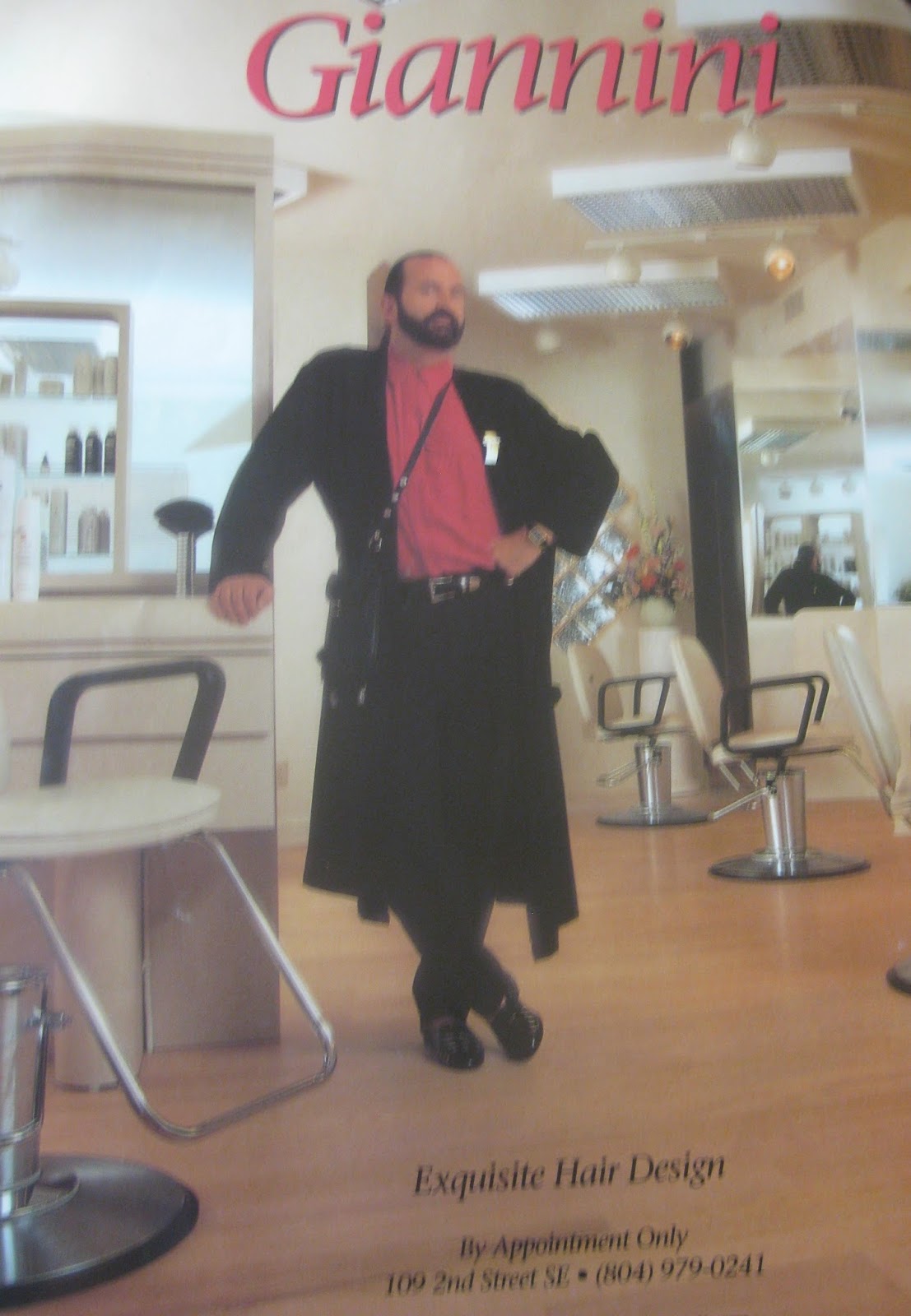
I didn’t have time to include a bit of Buck’s family history that mirrors his own struggles and successes. In christening the salon with his name, he was also calling forth the wanderlust and enterprise of his ancestor Antonio Giannini who, like buck, took a leap of faith at the age of 27. Antonio Giannini was one of several Italian laborers recruited by the merchant, Filipo Mazzei who had grand designs for establishing wine, silk, and olive oil business in Virginia.
Mazzei met Thomas Jefferson and with their shared interest in agricultural experimentation, Jefferson convinced Mazzei to try growing vineyards on land adjoining Monticello. Antonio Giannini went with him, arriving in Charlottesville in 1773.
At the end of his contracted 5 years of indentured service, Antonio was ready to enjoy some independence. When Mazzei left America for Europe to drum up support for the revolutionary cause in 1778, Antonio began working for Jefferson. Antonio then bought land in Albemarle county but when he was denied rights to build a mill on that land, he yearned to return to his home in Italy. His contract with Mazzei included a return passage at the end of his service. But with Mazzei back in Europe, Antonio sued Jefferson for indemnification for this promised return. He lost the suit. In his 50s Antonio became an ordained Baptist minister. Among his duties were officiating marriages in Albemarle, Louisa and Nelson counties. He was trapped in Charlottesville, just as Buck would be 200 years later. Both adapted to the situation—building the community they so yearned to be part of.
At the end of his contracted 5 years of indentured service, Antonio was ready to enjoy some independence. When Mazzei left America for Europe to drum up support for the revolutionary cause in 1778, Antonio began working for Jefferson. Antonio then bought land in Albemarle county but when he was denied rights to build a mill on that land, he yearned to return to his home in Italy. His contract with Mazzei included a return passage at the end of his service. But with Mazzei back in Europe, Antonio sued Jefferson for indemnification for this promised return. He lost the suit. In his 50s Antonio became an ordained Baptist minister. Among his duties were officiating marriages in Albemarle, Louisa and Nelson counties. He was trapped in Charlottesville, just as Buck would be 200 years later. Both adapted to the situation—building the community they so yearned to be part of.
September 20, 2015
Disappearing Mountain Lake
At first we thought the story was why Mountain Lake has been rising and falling to such extremes but that's actually just the nature of the lake. And you can actually learn a lot about the way the earth works from this cycle of emptying and refilling. I produced this story (with a lot of help from Kelley Libby!) for With Good Reason.
September 10, 2015
Building Permanance with the Urban Agriculture Collective of Charlottesville, Part 2
In my second piece on the Urban Agriculture Collective of Charlottesville I looked at how people are taking ownership of this organization as it evolves to face new challenges including a redevelopment plan.
You can listen to part one of this two part series here.
You can listen to part one of this two part series here.
August 20, 2015
Sowing Reciprocity at the Urban Agriculture Collective of Charlottesville, Part 1
I seem to be on an urban garden kick lately. But I find myself drawn to the communities that crop up around them.
The Urban Agriculture Collective of Charlottesville has so many facets and is forging community on so many levels that I decided to do a two part series on their work. Here's part one, which focuses on their unique economic model.
The Urban Agriculture Collective of Charlottesville has so many facets and is forging community on so many levels that I decided to do a two part series on their work. Here's part one, which focuses on their unique economic model.
August 6, 2015
Growing New and Old Roots
Charlottesville is a town that prides itself on welcoming people from around the world–-among them many refugees. Some of those refugees are working on a farm that’s actually giving them the opportunity to enrich our community and help us rediscover our roots. I am so grateful to New Roots Coordinator Brooke Ray and farmer Samyan Raouf for showing me around.
Go to the Saturday market on Michie Drive 2-5pm!
Go to the Saturday market on Michie Drive 2-5pm!
July 23, 2015
Feasting on Eid al-Fitr
For the first time in a few years Ramadan seemed to pass me by without much thought, so with the end of month of fasting drawing near, I headed for Grand Market. This grocery store on Charlottesville's Main Street is run by an Afghan family and has been my source for the best tahini and dates since moving back to town. There I met the owner Abdul Rahim who warmly pressed me to try all the cookies on display for Eid, the holiday that marks the end of Ramadan. I felt torn between the disrespect of eating in front of someone in the midst of a 17-hour fast and not wanting to reject his generosity. I decided I couldn't say no. He was happy, I was happy. Food just tastes better during Ramadan.
I also met Fawzia and Shirin (not their real names) who so exuberantly shared memories of their favorite Eid foods.
I also met Fawzia and Shirin (not their real names) who so exuberantly shared memories of their favorite Eid foods.
July 9, 2015
Zombie Debts
I first became interested in this topic when I read about a court case forcing JP Morgan Chase and Bank of America to update borrowers’ credit reports to reflect that the debts were extinguished through bankruptcy. The Legal Aid Justice Center in Charlottesville has a Zombie Debt Defense initiative. I spoke to one of their attorney's, Brenda Castaneda, and her client Lisa who has struggled with recurring debt sold and bought by different debt collectors also known as "zombie debt."
If anything, I hope to inspire activism against this insidious business. Let this This American Life segment be your inspiration!
If anything, I hope to inspire activism against this insidious business. Let this This American Life segment be your inspiration!
May 28, 2015
Quilting Connections
A few weeks ago I attended a traveling exhibition of quilts made by residents of the Beaumont Juvenile Correctional Center at The Bridge Progressive Arts Initiative. The more I talked to participants in the program and their instructor Roy Mitchell, the more I could see why these young men, separated from their friends and families, would be drawn to quilting. It's not just an antiquated craft popular among women of a certain age. No, the practice of making quilts offers the opportunity to renew social bonds. They're strengthening ancestral bonds with their grandmothers and great aunts who first exposed them to the craft and reconnecting with their families to whom they regularly send their creations. They have become so well-versed in the art and technique that they're even donating quilts to homeless shelters. It's no wonder then that they spend 9 hours a day working on their quilts. They're sewing themselves a connection to the world they've been separated from.
Apologies for the crummy sound quality--it was my first proper field recording. But oh what a fun way to start!
Apologies for the crummy sound quality--it was my first proper field recording. But oh what a fun way to start!
May 21, 2015
Remembering Vinegar Hill with Gundars Osvalds
There are so many points at which these photos might never have been. It's remarkable that Gundars Osvalds rediscovered them at a time when there was a venue and woman in Charlottesville interested in to displaying the images. Indeed the fact that he took them at all is surprising. What inspired him to explore a neighborhood he had never before stepped in just before its demolition? He didn't know he was capturing history so he doesn't really remember his motivations and impressions more than 50 years later. But he's been reflecting on what the photos mean now and shared some thoughts with me for WTJU's Soundboard.
May 7, 2015
Reflections on Nepal with Kiri and Bobong
The news coverage of the Nepalese earthquake has left much to be desired.* The trouble with the dry conveyance of facts is not only that its boring but also that it doesn't inspire curiosity or empathy for people who appear to be different from you. More and more I'm convinced that the way to get people to care about people over there and learn from big news stories is to deliver the news as stories, mini ethnographies of sorts.
So, as I was trying to capture a personal angle to the catastrophe, I came across several local connections to Nepal. Bobong Gurung is a native Nepali who now lives in Charlottesville and works as an interpreter for Nepali-speaking refugees. Kiri Van Lengen-Welty has spent time in Nepal volunteering for an organization called Empower Nepali Girls.
The 7.8 magnitude earthquake that struck Nepal on April 25th has wreaked havoc on the country. But even as the death toll continues to rise, these two Charlottesville residents suggested that there’s reason to have hope for the country’s future.
Bobong began by describing Dharahara, a lighthouse-like watchtower built in 1832, which was destroyed by the earthquake.
*For more on the problems of covering natural disasters see this On the Media piece.
So, as I was trying to capture a personal angle to the catastrophe, I came across several local connections to Nepal. Bobong Gurung is a native Nepali who now lives in Charlottesville and works as an interpreter for Nepali-speaking refugees. Kiri Van Lengen-Welty has spent time in Nepal volunteering for an organization called Empower Nepali Girls.
The 7.8 magnitude earthquake that struck Nepal on April 25th has wreaked havoc on the country. But even as the death toll continues to rise, these two Charlottesville residents suggested that there’s reason to have hope for the country’s future.
Bobong began by describing Dharahara, a lighthouse-like watchtower built in 1832, which was destroyed by the earthquake.
*For more on the problems of covering natural disasters see this On the Media piece.
April 23, 2015
Unpacking Coca-Cola with Bart Elmore
In his new book, Citizen Coke: The Making of Coca-Cola Capitalism, historian Bart Elmore complicates
the narrative that Coca-Cola’s rise to global empire is one of inimitable marketing
alone. His research shows how the company’s success has depended on an ever-expanding
exploitation of natural resources and taking advantage of public works and government
interventions. It's a very revealing look at how the
environmental costs shed by Coke have fallen on the public at large.
He also stressed the importance of giving historical figures depth. If we are to learn from the past, we can’t simply explain it away as mistakes made by evil people.
Coke’s model is not unique as Bart reminded me with his comparison to Wall Street commodity trading. And both models have ecological consequences that we have to reckon as we think about designing sustainable businesses for the future.
April 16, 2015
Authentic Cuisines with David Lebovitz
More than a decade ago David Lebovitz, a former pastry chef at
Chez Panisse, moved to Paris and started writing about his life there on his
blog and in many cookbooks. When I found
out that he was coming to Charlottesville, I knew I had to find a way to talk
to him. I have long read his blog as a voyeur on his life in Paris and for his
excellent recipes (this orange-glazed polenta cake is killer). His latest book, My Paris Kitchen, is a nominee
for a 2015 James Beard International Book Award. We spoke about why defining
"authentic" cuisines is tricky business and why he embraces a more
casual approach to cooking.
In our conversation, I mentioned how differently American-born chefs and immigrant chefs are portrayed on the scale of authenticity. Much of my thinking on this issue stems from a great exploration of the topic by Francis Lam and Eddie Huang. They hit on how standards of authenticity are related to power, class, media, and ultimately, why the representation of immigrant food matters so deeply.
In our conversation, I mentioned how differently American-born chefs and immigrant chefs are portrayed on the scale of authenticity. Much of my thinking on this issue stems from a great exploration of the topic by Francis Lam and Eddie Huang. They hit on how standards of authenticity are related to power, class, media, and ultimately, why the representation of immigrant food matters so deeply.
March 19, 2015
Sweet Briar's Past and Present with Lynn Rainville and Spencer Beall
Sweet Briar College's imminent closing has been particularly interesting to me as it opens up conversations about single-sex education the school's complicated past. I talked to Sweet Briar anthropology professor Lynne Rainville and alumna Spencer Beall about their thoughts on what will be lost with the College's closure this summer.
Based on historic wrangling over the intent of Indiana Fletcher Williams' will and what that means for Sweet Briar's mandate, Lynn Rainville predicts the current battle will be resolved in court.
Based on historic wrangling over the intent of Indiana Fletcher Williams' will and what that means for Sweet Briar's mandate, Lynn Rainville predicts the current battle will be resolved in court.
March 5, 2015
Cooking with Angelo Vangelopoulos
For more than 20 years one local chef has been proving that
food can be the means to connect us and foster community. Last week Angelo
Vangelopoulos, chef and owner of the Ivy Inn, was recognized for his excellence
when he was named a James Beard Award semifinalist in the best chef category.
In addition to his enthusiasm for cooking, Angelo shared his
passion for changing the American plate. Yes, Americans need to eat less meat but Angelo’s message is
not just one of deprivation. Indeed, he finds himself more and more drawn to the
complexity and rewards of cooking vegetables these days.
His hope for a more sustainable future stems from seeing a
man revel in his market haul. He suggested that one day we might find a joy and
entertainment in food rivaling that which our phones now provide.
February 24, 2015
The Productivity of Debt: Terry Vassalos
Underlying the debates over how to resolve Greece's debt
crisis is the assumption that the country’s debt poses a risk to the
credibility and strength of Europe. On that premise, the looming insolvency of
Greece’s banks seems to beckon the unraveling of European integration.
 |
| Terry Vassalos at the counter. Photo courtesy of Tip Top. |
From the corner booth of his perpetually crowded restaurant,
Tip Top, Terry Vassalos too is worried about Europe. But debt? Not so much. Debt is what keeps his restaurant full. “Four
or five years ago one of our customers, an older guy read in the newspaper that
Carmax was opening in the area. He must have assumed that they were taking over
our location. He walked in the door and in
the middle of a full house he started cussing me out ‘I cannot believe you sold
the restaurant.’ He didn’t give me time to explain. ‘I come here every day and
you sold the restaurant. No respect.’ Finally I said to him, ‘no I didn’t. It’s
next door.’ It was at that moment that he realized the deep network of
obligation he had fostered over the fifteen years he has owned Tip Top. Yes,
he’s running a business where you give money in exchange for a meal but the
contract of hospitality doesn’t end with check when you’re building a community.
The warmth of that community, however, doesn’t blind him to the woes of Europe
and his home country of Greece.
At the end of January the SYRIZA party came to power
promising the end to austerity measures (including higher taxes and cuts to
public spending) imposed as a condition of the country’s bailout in the wake of
the European debt crisis in 2010. This reversal on the country’s commitments to
international creditors came just as the country’s latest bailout agreement was
set to expire on Feb 28. The pressure to come to an agreement on the terms for
disbursement of the last bailout tranche before the end of the month was
bearing down on both parties as Greece’s banks would quickly become insolvent without
new credit (debt).
When I met with Terry last week there was still uncertainty
over whether Greece would reach consensus with its European creditors, who were
calling for a renewal of the lending program. On the other hand Greece’s
finance minister, Yanis Varoufakis, who attributes the country’s “humanitarian
crisis” to the austerity measures was resistant to the idea of taking out
another loan with the imposed reforms. He was fighting for a renegotiation ofthe whole bailout: “Would you advise them that they should continue to take
these tranches of loans from the credit card in order to deal with what is
essentially an insolvency problem?” As the auditors responsible for ensuring
the Greek government meets the reform demands of the bailout, the troika—the
European Commission, the European Central Bank, and the IMF—has become the
focus of the country’s ire.
Terry is sensitive to the consequences of the austerity
measures on his family still living in Greece and the country as a whole. He
notes that his sister and brother are seeing their retirement benefits cut.
They avoid using their cars as much as they can with oil prices skyrocketing. “This
country deserves much more than where it is now.” But Terry locates the origins
of Greece’s current trouble to a period way before the last five years of
supervision by the troika. He points to years of corruption at the government
level that has trickled down to make bribery and payoffs a constant part of his
family’s business life.
But he is hopeful that SYRIZA’s election will herald a new
beginning in politics. “One thing for sure is the new government is not
corrupt. They’re never been in power. They have enthusiasm.”
That enthusiasm has been worrying Greece’s European
creditors who have been stressing that the country is bound to repay the loans
by the rules of the market. Whatever freewheeling leftist ideas SYRIZA may have
a democratic mandate for, finance ministers from Eurozone countries (which own
60% of Greece’s debt) insist that the many rounds of bailout loans are a
contract established in the free marketplace. A market where you cannot trust
the other actors to pay their debts is one without credibility, or so the
mantra goes. And who’s going to invest in a market without credibility? This is
where the language around the economy reveals that it is a fragile construction
based on confidence. Among other things, markets only work if investors have
confidence that debts will be repaid. If Greece defaulted on its loan payments,
it would break that underlying premise and “Grexit” would have been the only
option.
When I asked Terry for his predictions on an outcome to the
negotiations he told me about his last visit to Greece two months ago. “The oil
price was $7/gallon. Heating oil was $5/gallon. They’re not buying it. They’re
not going to buy if they don’t have the money. Everyone knows Greece cannot
repay loans. You can’t beat a dead horse. You have to give them a break.” The suggestion
that Greece default on its loans seems pretty radical (until you realize ajubilee isn’t just a feature of the bible).
After all the idea that one must pay one’s debt is ingrained
into our conception of market exchange. But it carries such weight because, as anthropologist David
Graeber points out, “it’s not actually an economic statement: it’s a moral
statement.” In other words it’s not a given that borrowers must pay back their
debts incurred on the market. It requires heavy reinforcement by our moral code.
Debt becomes inherently bad when leaders draw on regional stereotypes to
explain the crisis as a struggle between irresponsible borrowers and prudent
lenders. In this line of thinking austerity measures must be painful. They are
penance for accumulating debt.
Of course as many have pointed out, an irresponsible borrower is only possible with an irresponsible lender.
It is only through taking the risk inherent in investment that production and
growth is possible. Credit or debt relationships enable investment and
production. So what is the productivity of Greek debt? According to Terry, bailing
out Greece represents an investment in the European project: the conceit that
shared prosperity builds peace and democracy. It’s a risky investment but one
that Terry believes in.
Terry points out that the strategy behind European loans to
Greece is multifarious. “What they have done so that the European banks do not
go bankrupt is to loan them [the Greek government] more money so they can pay
the interest back.” This echoes arguments made since 2012 that loans to Greece
represent a bailout of its creditor countries. Ultimately, the benefits of these loans are intended to bolster Europe as a
whole not just the immediate recipient.
When Terry brings up Germany’s occupation of Greece during
World War II, he isn’t calling for reparations. Many have pointed out the
futility of blaming others for the current state of Greece.
He’s well aware of the damage that generations of government corruption have
wreaked on his country. No, he harkens back to the history of loans and debts
made between European countries to give context to the current discussions. “I
mean that’s in the past but it’s not so far in the past.”
There are debts at the heart of the European project and accounts
don’t balance out when people are involved. Debts create enduring social bonds.
Currently Greece’s debt crisis is testing the strength of
those bonds. Terry understands the argument that reducing Greece's debt might
damage Europe's credibility by undercutting the truism that debts will be paid.
But by acting as Germany's debt collector, he feels the Eurogroup is compromising the interests of the Greek people. “How can you say you’re bringing growth
across Europe when there are so many poor people? Isn’t that the point of the
Eurozone, that we’re stronger together?”*
A moralized understanding of debt makes shared prosperity
seem impossible. It reduces the debate to two options: European growth against
Greek growth. The two should be intertwined, at least according to the
principals of the European project. In this ambiguous statement German Chancellor Angela Merkel seems to agree: “but one must add that Europe’s credibility depends
on sticking to the rules and that we are reliable for each other.”
So how do you bring about shared prosperity? Terry freely
admits that he doesn’t have the answer. Instead he offers a reminder of the
risk inherent in investing. “I think they have to be more flexible. You invest
your money and then it’s going to take time to get it back. Maybe it’s going to
take a bit longer.” The European community took a risk on Germany; it took a
risk on Ireland etc. These credit debt relations have been productive and they
have the potential to bring about further prosperity that is fundamentally
shared.
Back at Tip Top, Terry Vassalos is pointing to a corner
table where residents from a retirement home in the area eat twice, if not three
times a day, every day of the week. “I don’t understand why because I love this
place too but I cannot go to one place everyday. But it’s ok they know people.
They meet people.” Together they are swapping
cold weather horror stories, bemoaning the latest road construction mayhem, and
imagining the new and improved downtown cinema. Seems like the perfect incubator for negotiating
a shared prosperity. Wishful thinking? Well, have you tasted their buckwheat
pancakes?
*This gets to the question of whether individuals should be
held responsible for repaying government debt through austerity measures in
order to, so the argument goes, keep the markets, banks and economy going.
January 29, 2015
History of Capitalism with Julia Ott and Louis Hyman
I just started producing a weekly public affairs show on WTJU
called Soundboard. I’ll be posting some of the segments I produce on this blog
along with thoughts that didn’t make it on air.
The first interview I recorded for Soundboard was with two historians who are
looking at the particular forms that capitalism has taken throughout our
history, analyzing it as a representation of particular policies and
intellectual ideas rather than a timeless feature in our lives. JULIA OTT,
associate professor of history at the New School, and LOUIS HYMAN, assistant
professor of history at Cornell University are among those scholars showing
that when it comes to our economic system, history can be instructive for
giving us a sense of where we are.
They’re essentially questioning things we take
for granted about the way our economy functions by showing that it’s not
something that exists outside of us. It has evolved throughout history and we
have shaped it. By exploring how capitalism looked at different moments, they give
us the tools to reconsider how it works now. Very anthropological, if I do say
so myself.
Subscribe to:
Posts (Atom)